Hydrotherapy for Parkinson's Disease: Water-Based Exercises to Improve Balance, Gait, and Quality of Life
Why Hydrotherapy Is Particularly Effective for Parkinson's
Parkinson's disease is characterised by the loss of dopamine-producing neurons, leading to movement difficulties including bradykinesia (slowness), rigidity, tremor, and postural instability. Water therapy addresses these symptoms through mechanisms described in detail in our science of hydrotherapy article:
- Fall-safe environment: Up to 68% of Parkinson's patients fall each year, and fear of falling leads to inactivity that accelerates decline. Water eliminates fall injury risk, giving patients the confidence to challenge their balance
- Rigidity reduction: Warm water (33-35°C) decreases muscle tone and rigidity, allowing a greater range of movement than patients typically achieve on land
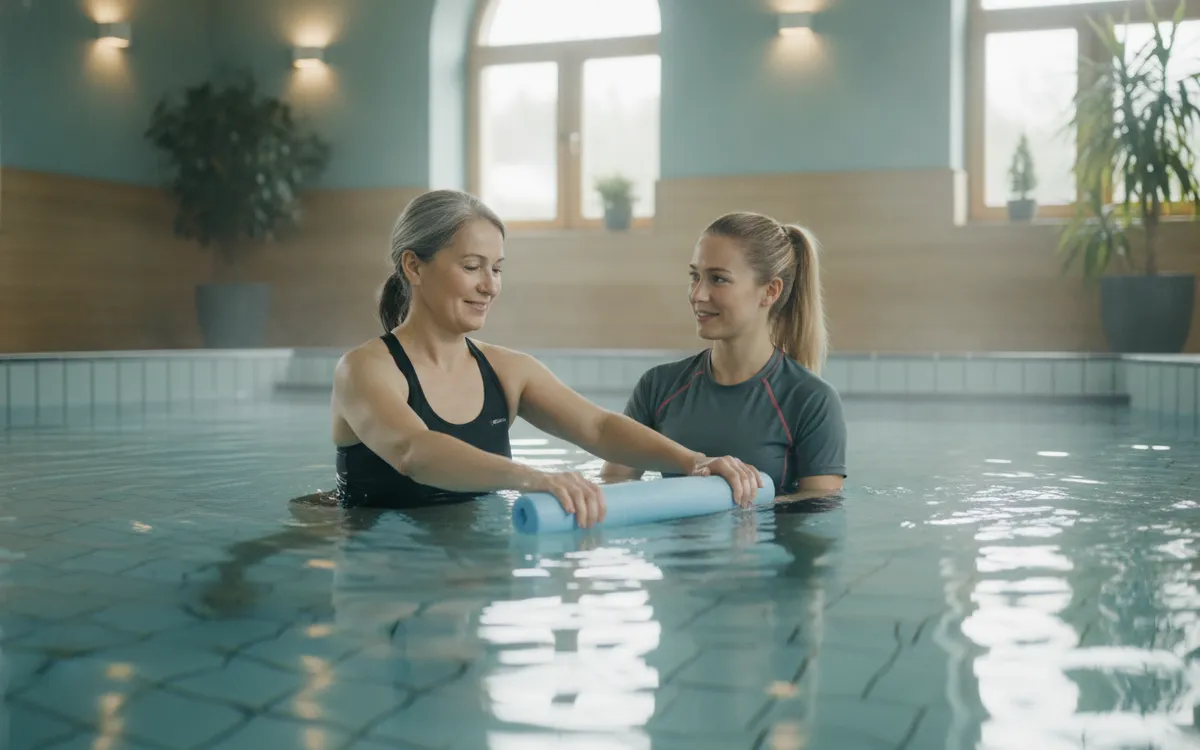
- External cueing: Water resistance provides constant sensory feedback that serves as an external movement cue — one of the most effective strategies for overcoming Parkinson's movement hesitation
- Dual-task training: The multisensory water environment naturally engages cognitive and motor systems simultaneously, training the brain-body connection that Parkinson's disrupts
- Cardiovascular support: Hydrostatic pressure supports venous return, compensating for the orthostatic hypotension (blood pressure drops when standing) common in Parkinson's
Evidence for Aquatic Therapy in Parkinson's
| Study | Participants | Protocol | Key Outcomes |
|---|---|---|---|
| Carroll et al., 2023 (Parkinsonism & Related Disorders) | Systematic review, 14 RCTs | Various aquatic protocols | Aquatic therapy significantly improved balance, gait speed, and quality of life vs. no exercise |
| Volpe et al., 2022 (Neurorehab & Neural Repair) | 34 PD patients (Hoehn-Yahr 2-3) | 8 weeks, 2x/week, 32°C | 42% improvement in balance (Mini-BESTest); reduced falls over 6-month follow-up |
| Pompeu et al., 2023 (Clinical Rehabilitation) | 40 PD patients | 12 weeks aquatic vs. land-based | Aquatic group showed greater gait speed improvement (0.12 m/s vs. 0.05 m/s) and better Unified PD Rating Scale scores |
| Ayán & Cancela, 2022 (Arch Physical Med Rehab) | 30 mild-moderate PD | 12 weeks, 2x/week | Significant improvements in functional reach, Timed Up & Go, and reduced freezing episodes |
| Pérez-de la Cruz, 2023 (Complementary Therapies) | 28 PD patients | Ai Chi protocol, 10 weeks | Improved trunk stability, reduced rigidity (Modified Ashworth Scale), improved mood scores |
A striking finding from the Volpe et al. study: the balance improvements from 8 weeks of aquatic therapy were still measurable 6 months later, and the aquatic group had 60% fewer falls during the follow-up period compared to the control group.
Aquatic Exercise Programme for Parkinson's
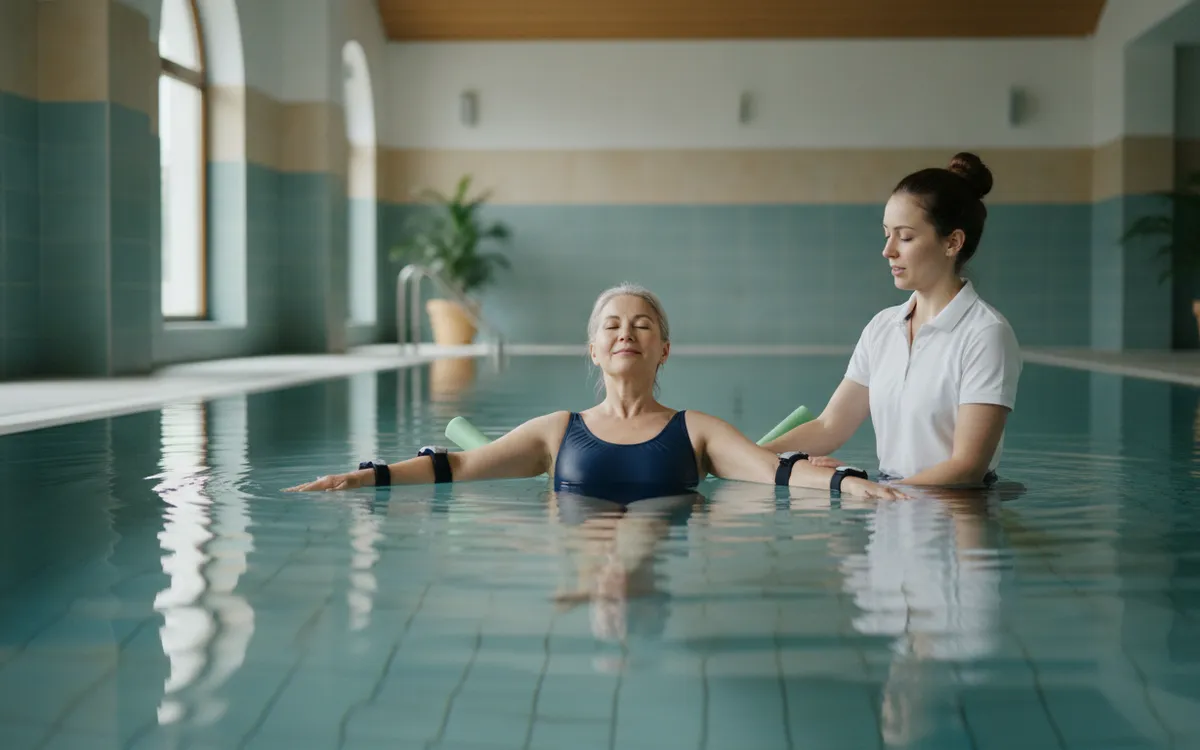
The following programme is designed for patients with mild to moderate Parkinson's (Hoehn-Yahr stages 1-3). All exercises should be performed in warm water (32-35°C) with appropriate supervision. The programme progresses through three focus areas within each session.
Warm-Up: Rigidity Reduction (8-10 Minutes)
| Exercise | Purpose | How to Perform | Duration |
|---|---|---|---|
| Slow walking | Warm up, reduce rigidity | Walk forward in chest-deep water with exaggerated arm swings | 3-4 min |
| Shoulder circles | Upper body mobility | Large, slow shoulder circles forward and backward | 10 each direction |
| Trunk rotation | Spinal mobility (often severely restricted) | Arms across chest, rotate torso left and right | 10 each side |
| Neck mobility | Cervical flexibility | Gentle head turns and tilts in the water | 5 each direction |
Balance Training (15 Minutes)
Balance impairment is the single greatest risk factor for Parkinson's-related injury. Aquatic balance training is more effective than land-based training because patients can be challenged more aggressively without fall risk.
| Exercise | Purpose | How to Perform | Sets/Reps |
|---|---|---|---|
| Weight shifting | Lateral stability | Shift weight fully from left foot to right, pause 3 sec each side | 10 per side |
| Tandem walking | Narrow base of support | Walk heel-to-toe along pool lane line in waist-deep water | 3 pool lengths |
| Single-leg stance | Unipedal balance | Stand on one leg, pool wall nearby for safety, hold 10-30 sec | 3 per leg |
| Perturbation response | Reactive balance | Partner or therapist creates gentle waves; maintain balance | 8-10 challenges |
| 360° turns | Turning balance (major fall trigger) | Slowly turn full circle in waist-deep water, both directions | 3 each direction |
| Backward walking | Retropulsion training | Walk backward in chest-deep water, focus on upright posture | 2 pool lengths |
Gait Training (10-15 Minutes)
Freezing of gait and festination (shuffling, accelerating steps) are hallmark Parkinson's symptoms that significantly increase fall risk. Water provides external cueing through resistance that helps break these patterns.
| Exercise | Purpose | How to Perform | Duration |
|---|---|---|---|
| Exaggerated stepping | Combat shuffling gait | Walk with deliberate large steps, lifting knees high | 4 pool lengths |
| Rhythmic walking to music | External auditory cueing | Walk to music with a clear beat, matching steps to rhythm | 5 min |
| Obstacle navigation | Adapt gait pattern | Step over floating objects placed across the pool | 3 pool lengths |
| Speed variation walking | Gait control and adaptability | Alternate slow and fast walking on therapist command | 4 min |
| Directional changes | Turn initiation (anti-freezing) | Walk and change direction on command (left turn, right turn, U-turn) | 5 min |
Strengthening (10 Minutes)
| Exercise | Muscle Groups | How to Perform | Sets/Reps |
|---|---|---|---|
| Wall squats | Quadriceps, glutes | Back against wall, lower to 45°, hold 5 sec | 2 x 10 |
| Calf raises | Ankle plantar flexors | Rise on toes holding pool edge, lower slowly | 2 x 15 |
| Bicep curls with paddles | Upper arms | Curl water resistance paddles | 2 x 12 |
| Side-stepping | Hip abductors | Step sideways against water resistance | 2 x pool width |
| Chest press against water | Pectorals, shoulders | Push palms forward against water at chest height | 2 x 12 |
Cool-Down: Flexibility and Relaxation (5-8 Minutes)
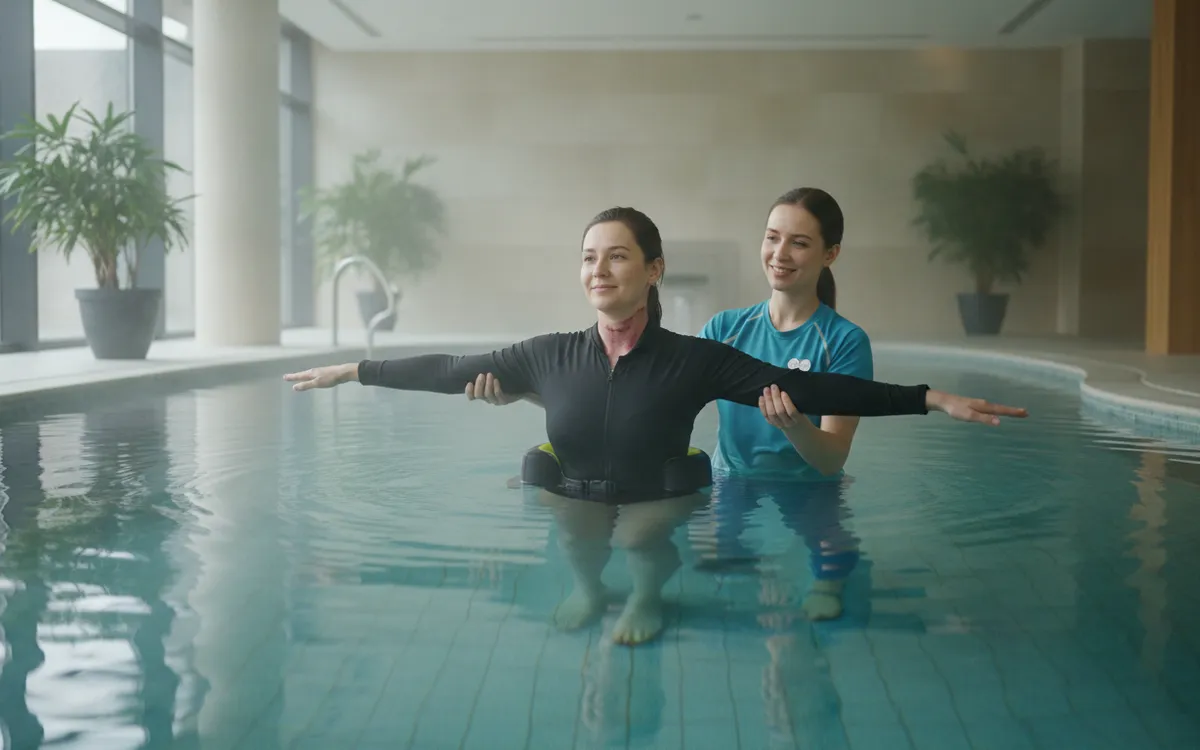
- Ai Chi movements: Slow, flowing arm movements in shoulder-deep water — particularly beneficial for Parkinson's rigidity
- Hamstring stretch: Place heel on pool step, lean forward gently — 30 seconds per leg
- Chest stretch: Arms behind back, clasp hands, gently lift — 30 seconds
- Deep breathing: Slow diaphragmatic breathing, focus on the calming sensation of the warm water
Addressing Freezing of Gait in Water
Freezing of gait (FOG) — the sudden inability to initiate or continue stepping — is one of the most disabling Parkinson's symptoms. It occurs in up to 80% of advanced PD patients and is a major cause of falls. Aquatic therapy offers unique strategies for FOG:
- Water resistance as external cue: The constant resistance of water provides the kind of external sensory input that helps override freezing. Many patients who freeze on land walk smoothly in water
- Visual cueing with pool lines: Lane markings on the pool floor serve as visual cues to step over — a proven anti-freezing strategy
- Rhythmic music in the pool: Auditory cueing with waterproof speakers playing rhythmic music helps maintain gait rhythm
- High-step practice: Practising exaggerated stepping in water teaches motor patterns that can transfer to land-based situations where freezing typically occurs
The Ayán & Cancela (2022) study found a significant reduction in freezing episodes after 12 weeks of aquatic therapy, with patients reporting that the strategies learned in the pool helped them manage freezing on land.
Home Water Therapy for Parkinson's
Between pool sessions, home water therapy can help maintain gains. Our bath therapy guide covers setup details:
- Warm bath for rigidity: A 15-20 minute warm bath (36-38°C) before bed can reduce nighttime rigidity and improve sleep quality
- Hand exercises in warm water: Fill a basin with warm water and practise finger spreads, fist making, and object manipulation to maintain hand dexterity
- Foot exercises in bath: Ankle circles, toe curls, and foot flexion in warm water help maintain the ankle mobility needed for walking
- Shower balance practice: With appropriate grab bars installed, practise standing on one leg briefly during a warm shower (ensure non-slip mat is in place)
For those considering home pool options, our home pool guide and equipment guide review appropriate options. Temperature control is important — look for pools that maintain 32-35°C for therapeutic benefit.
Safety Considerations
Our guide to hydrotherapy risks covers general safety, and here are Parkinson's-specific considerations:
- Medication timing: Schedule pool sessions during "on" periods (when medication is working optimally) for best results and safety. Avoid the pool during "off" periods when movement is most impaired
- Supervision requirement: Always have a trained professional or capable carer present. Freezing, dyskinesia, or sudden off periods can occur unpredictably
- Pool entry/exit: Use ramps or hoists rather than ladders, which require fine motor coordination and balance
- Orthostatic hypotension: Stand up slowly when exiting the water — the shift from hydrostatic support to gravity can cause blood pressure drops
- Cognitive fluctuations: If cognitive impairment is present, increased supervision and simpler exercise programmes are needed
- Dyskinesia management: Involuntary movements from medication can make some pool exercises challenging — adapt the programme to the patient's current state
Building Parkinson's Aquatic Therapy Into a Complete Programme
Aquatic therapy is most effective as part of a comprehensive Parkinson's exercise programme. Our comparison of hydrotherapy and physical therapy explores how they complement each other:
| Component | Frequency | Focus |
|---|---|---|
| Aquatic therapy | 2x/week | Balance, gait, rigidity reduction |
| Land-based physiotherapy | 1-2x/week | Strength, functional movement |
| Dance/rhythm therapy | 1x/week | Coordination, rhythm, social engagement |
| Walking programme | Daily | Endurance, real-world gait practice |
| Home exercises | Daily | Flexibility, hand exercises, balance |
For patients who are also managing pain alongside Parkinson's, our condition-specific guides for back pain, shoulder pain, knee pain, and hip pain provide additional water-based pain management strategies.
Frequently Asked Questions
Is hydrotherapy proven to help Parkinson's disease?
Yes. Multiple systematic reviews and randomised controlled trials have demonstrated that aquatic therapy significantly improves balance, gait speed, rigidity, and quality of life in Parkinson's patients. The Carroll et al. (2023) systematic review of 14 trials concluded that aquatic therapy produces clinically meaningful improvements compared to no exercise, and may produce greater balance improvements than equivalent land-based exercise. While hydrotherapy does not slow the underlying disease progression, it effectively maintains and improves the functional abilities that Parkinson's threatens.
How often should Parkinson's patients do aquatic therapy?
Research supporting significant benefits typically uses 2-3 sessions per week, each lasting 45-60 minutes. Consistency is more important than frequency — 2 sessions per week performed regularly produces better outcomes than 3 sessions per week performed sporadically. Many patients start with 2 sessions and adjust based on energy levels and response. Sessions should be spaced throughout the week to allow recovery between sessions while maintaining momentum.
Can someone with advanced Parkinson's still benefit from water therapy?
Yes, though the programme must be adapted for the patient's ability level and require closer supervision. Patients with advanced Parkinson's (Hoehn-Yahr stages 4-5) can benefit from warm water immersion for rigidity reduction, supported exercises for maintaining range of motion, and the psychological benefits of being in a pleasant environment. Pool hoists and one-to-one supervision are essential for safe access. Even gentle, supported movement in warm water provides meaningful quality-of-life improvements for advanced patients.
Does the water temperature matter for Parkinson's hydrotherapy?
Yes, temperature significantly affects outcomes. Water at 33-35°C (91-95°F) is optimal for reducing rigidity and allowing comfortable exercise. Cooler water (below 31°C) may increase muscle stiffness, while very warm water (above 36°C) can cause fatigue and may interact with blood pressure medications common in Parkinson's treatment. If the therapy pool is cooler than ideal, spend the first 5-10 minutes walking gently to warm up before beginning targeted exercises.
Will exercises learned in the pool transfer to movement on land?
Research shows that aquatic exercise benefits do transfer to land-based function. The Volpe et al. (2022) study found that balance improvements from pool-based training were measurable on land-based balance tests, and — most importantly — resulted in fewer real-world falls over 6 months. The mechanisms likely involve neuroplasticity: repeated successful movement in water strengthens neural pathways that also serve land-based movement. However, a combined programme including both aquatic and land-based exercise produces the best transfer effects.
]]>