Hydrotherapy for Rheumatoid Arthritis: Water-Based Therapy to Ease Inflammation, Stiffness, and Joint Damage
Why Water Therapy Is Uniquely Effective for Rheumatoid Arthritis
Rheumatoid arthritis (RA) is an autoimmune condition where the body's immune system attacks the synovial lining of joints, causing chronic inflammation, pain, and progressive joint destruction. Unlike osteoarthritis, which is driven by mechanical wear: RA involves systemic inflammation that can affect multiple joints simultaneously, making land-based exercise painful and sometimes counterproductive during flares.
Water provides an ideal exercise environment for RA patients because buoyancy reduces joint loading by up to 90%, warm water decreases muscle guarding and pain perception, and hydrostatic pressure helps reduce inflammatory swelling. The combination allows patients to maintain joint mobility and muscle strength during periods when land-based activity would be too painful.
If you're looking for general arthritis information, our comprehensive guide on hydrotherapy for arthritis covers both osteoarthritis and RA. This article focuses specifically on RA's unique challenges and the aquatic protocols that address them. For foundational concepts, see the science behind hydrotherapy.
Research Evidence for Aquatic RA Therapy
Multiple randomised controlled trials have demonstrated that aquatic exercise is both safe and effective for RA, with particular benefits for disease-related fatigue and functional capacity.
| Study | Participants | Protocol | Key Finding |
|---|---|---|---|
| Al-Qubaeissy et al. (2013) | Systematic review, 7 RCTs | Various aquatic programs | Significant improvements in joint tenderness, knee ROM, and emotional well-being |
| Siqueira et al. (2017) | 60 RA patients | Warm water exercise vs. land exercise, 16 weeks | Both effective; aquatic group showed greater pain reduction and better adherence |
| Eversden et al. (2007) | 115 RA/AS patients | Hydrotherapy vs. land physiotherapy, 6 weeks | Hydrotherapy produced immediate well-being improvements; sustained at 3-month follow-up |
| Bilberg et al. (2005) | 46 RA patients | Moderate-intensity pool exercise, 12 weeks | Improved aerobic capacity and grip strength without increasing disease activity |
A critical finding across studies: properly dosed aquatic exercise does not increase RA disease activity or trigger flares, a concern that historically limited exercise recommendations for RA patients.
How RA Differs from OA in Water Therapy
While our general arthritis guide covers osteoarthritis (OA) extensively, RA requires different considerations:
- Flare management: RA has unpredictable flares where inflammation spikes. During flares, reduce exercise intensity but continue gentle water-based movement to prevent stiffness
- Symmetric joint involvement: RA typically affects joints on both sides of the body, so exercises should be bilateral
- Fatigue factor: RA-related fatigue is often more debilitating than pain. Water's buoyancy reduces the energy cost of movement by up to 50%
- Small joint involvement: RA commonly affects hands and feet early. Include specific fine-motor water exercises for these joints
- Systemic inflammation: Temperature must be carefully managed to avoid worsening systemic inflammatory response
Aquatic Exercises for Rheumatoid Arthritis
Warm-Up: Gentle Walking and Swaying
Purpose: Gradually increases joint temperature, blood flow, and synovial fluid production without stressing inflamed joints.
How: Walk slowly in chest-deep warm water (33 to 34°C) for 3 to 5 minutes. Allow your arms to sway naturally through the water. Gently shift your weight from side to side, letting the water support your movement. Focus on smooth, continuous motion rather than speed.
Why: The warm water and gentle movement increase synovial fluid viscosity reduction (it becomes more lubricating when warm), while buoyancy eliminates the jarring impact of walking on land.
Underwater Hand and Finger Exercises
Purpose: Maintains hand dexterity and grip strength, critical for RA patients who commonly lose hand function.
How: Submerge your hands and forearms in the water. Open and close your fists slowly 10 times. Then spread your fingers wide and bring them together 10 times. Next, touch each fingertip to your thumb in sequence. Finally, use a soft underwater ball, squeeze gently for 3 seconds and release. The water's resistance provides gentle strengthening while its warmth reduces stiffness.
Why: RA frequently affects the metacarpophalangeal (MCP) and proximal interphalangeal (PIP) joints first. Early and consistent hand exercises in warm water preserve function and delay deformity progression.
Bilateral Shoulder Circles
Purpose: Maintains shoulder ROM and prevents the frozen shoulder pattern common in RA.
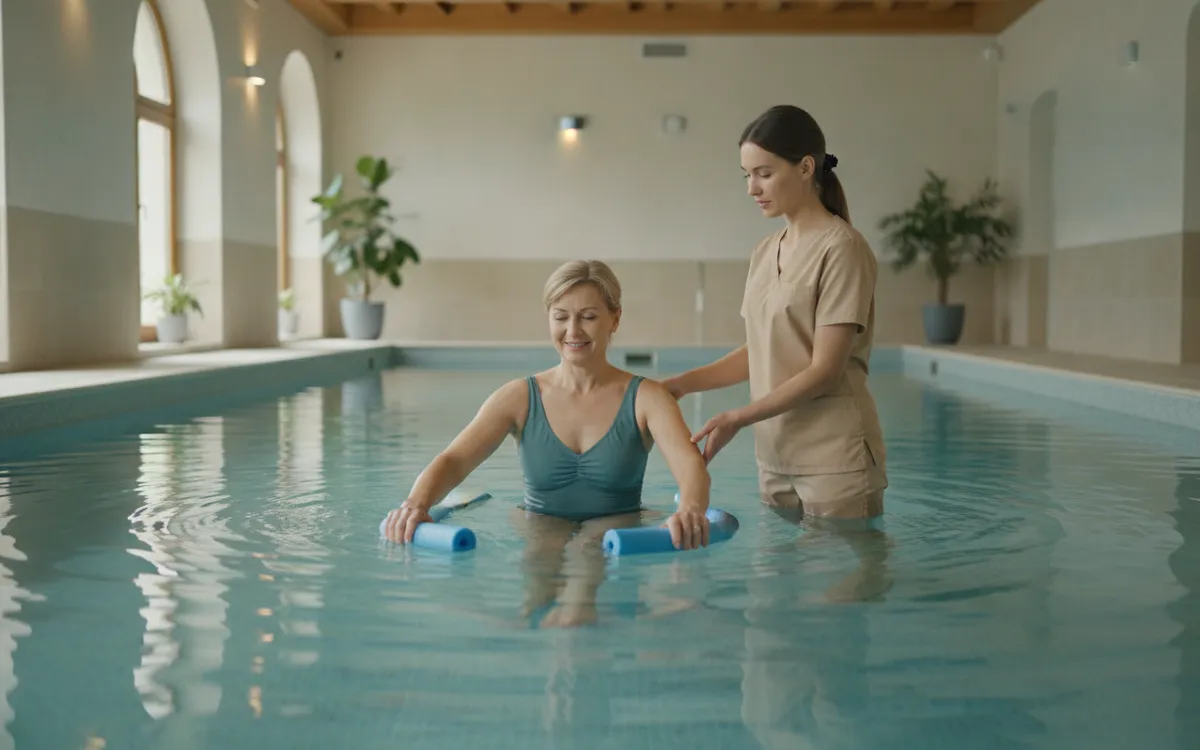
How: Stand in shoulder-deep water. Simultaneously rotate both shoulders forward in slow circles, 10 rotations forward, then 10 backward. The water provides equal resistance in all directions while supporting the weight of your arms. Keep movements smooth and within your pain-free range.
Why: The shoulders are commonly involved in RA. Water's buoyancy supports the arms (which weigh 4 to 5 kg each on land) while providing gentle resistance to maintain rotator cuff and deltoid strength. For more shoulder-specific exercises, see our hydrotherapy for shoulder pain guide.
Supported Knee Bends
Purpose: Strengthens quadriceps and maintains knee ROM without compressive joint loading.
How: Stand with your back against the pool wall in chest-deep water. Slowly bend both knees to a comfortable depth (aim for 30 to 45 degrees, not a full squat). Hold for 3 seconds, then straighten. The water's buoyancy should make this feel significantly easier than on land. Perform 8 to 12 repetitions, rest, and repeat 2 to 3 sets.
Why: Knee involvement occurs in over 60% of RA patients. Maintaining quadriceps strength is essential for joint stability and fall prevention. Water reduces effective body weight to just 10 to 25% of land weight, protecting inflamed joints. See also our dedicated hydrotherapy for knee pain guide.
Aquatic Tai Chi Movements
Purpose: Combines gentle ROM, balance training, and stress reduction in a meditative water practice.
How: In waist-to-chest-deep water, perform slow, flowing movements inspired by tai chi. Push hands forward and pull back, shift weight from one foot to the other, and rotate your trunk gently. Focus on deep breathing and continuous movement for 10 to 15 minutes. The water's resistance slows all movements naturally, making it ideal for the tai chi approach.
Why: Tai chi has proven benefits for RA including reduced pain, improved balance, and decreased disease activity. Performing these movements in warm water enhances the benefits through hydrostatic pressure and buoyancy. For a similar approach, explore aqua yoga techniques.
Temperature Protocols for Rheumatoid Arthritis
| RA Phase | Temperature | Duration | Rationale |
|---|---|---|---|
| Active flare (high inflammation) | 30 to 32°C (86 to 90°F) | 15 to 20 minutes | Moderately warm; avoids worsening inflammation while providing pain relief |
| Low disease activity | 33 to 35°C (91 to 95°F) | 30 to 45 minutes | Warmer water for maximum stiffness relief and exercise comfort |
| Morning stiffness management | 34 to 36°C (93 to 97°F) | 10 to 15 minutes | Brief warm soak to address RA's characteristic morning stiffness |
| Post-exercise cool-down | 28 to 30°C (82 to 86°F) | 5 to 10 minutes | Gentle cooling to manage exercise-related inflammation |
Flare-day protocol: During flares, do not skip water therapy entirely. Instead, reduce to gentle ROM exercises in warm water for 15 minutes. Complete rest during flares leads to rapid deconditioning and increased stiffness. For detailed temperature guidance, see our pool temperature guide.
Home Water Therapy for RA
Daily home water therapy can significantly supplement formal pool sessions:
- Morning warm hand soaks: Soak hands in warm water (38°C) for 10 minutes each morning to combat RA's characteristic morning stiffness, then perform gentle finger exercises
- Paraffin-like wax baths: Warm water hand baths provide similar (though less intense) benefits to paraffin wax treatments commonly used in RA clinics
- Contrast therapy for feet: Alternate 3 minutes warm, 1 minute cool to stimulate circulation in RA-affected feet, learn more in our contrast water therapy guide
- Evening bath with gentle exercises: A warm bath before bed with gentle joint ROM exercises can reduce night-time stiffness and improve sleep, see our bath therapy guide and sleep quality article
For a complete home setup, see our guide on building a home hydrotherapy routine. Equipment recommendations are available in our affordable equipment guide.
Safety Considerations for RA Patients
- Immunosuppressive medications: Many RA patients take immunosuppressants, ensure pool hygiene is excellent and avoid pools during illness outbreaks
- Joint instability: Advanced RA can cause joint subluxation. Avoid high-resistance movements and use pool rails for support
- Cervical spine involvement: RA can affect the cervical spine (C1-C2 instability). Avoid vigorous neck movements in water and discuss cervical precautions with your rheumatologist
- Vasculitis risk: Some RA patients have vasculitis. Extreme temperature variations should be avoided
- Monitor disease activity: If joints are more swollen or tender after aquatic sessions, reduce intensity. If symptoms persist, consult your rheumatologist
For a complete overview of water therapy risks, see our guide on hydrotherapy disadvantages and contraindications.
Frequently Asked Questions
Can hydrotherapy cure rheumatoid arthritis?
No: RA is a chronic autoimmune condition with no current cure. Hydrotherapy is a supportive therapy that helps manage symptoms including pain, stiffness, fatigue, and reduced mobility. It works best alongside your prescribed disease-modifying medications (DMARDs), not as a replacement. Many patients report that regular aquatic therapy significantly improves their quality of life and functional ability.
Is it safe to exercise in water during an RA flare?
Yes, but with modifications. During active flares, switch from strengthening exercises to gentle range-of-motion movements in warm water. Reduce session duration to 15 to 20 minutes and lower intensity. The warm water and hydrostatic pressure can actually help reduce flare-related swelling and pain. Complete rest during flares is no longer recommended as it leads to rapid deconditioning.
How does hydrotherapy for RA differ from hydrotherapy for osteoarthritis?
The main differences involve temperature management (RA requires careful avoidance of excessive heat during flares), the need for bilateral exercises (RA affects joints symmetrically), inclusion of hand and fine-motor exercises (RA commonly affects small joints), and fatigue management (RA causes systemic fatigue requiring shorter, more frequent sessions). Our general arthritis guide covers OA in more detail.
How often should RA patients do aquatic therapy?
Research supports 2 to 3 pool sessions per week, each lasting 30 to 45 minutes during low disease activity. During flares, maintain frequency but reduce duration to 15 to 20 minutes of gentle movement. Daily home warm water hand soaks of 10 minutes can supplement pool sessions. Consistency over months produces the best long-term outcomes for maintaining function and reducing pain.
Will swimming aggravate my rheumatoid arthritis?
Swimming is generally well-tolerated by RA patients, but certain strokes may stress specific joints. Backstroke and freestyle with a relaxed kick are usually best tolerated. Breaststroke can stress the knees and hips, so modify or avoid it if these joints are affected. Water walking and aquatic exercises may be better options than lap swimming during periods of higher disease activity.