Underwater Treadmill vs Swimming: Which Aquatic Exercise Burns More Calories, Builds More Strength, and Suits Your Goals?
Two Popular Aquatic Exercises Compared
Underwater treadmills and swimming are two of the most widely used forms of aquatic exercise, but they serve quite different purposes and deliver different results. Whether you're rehabilitating an injury, training for fitness, managing a chronic condition, or trying to lose weight, understanding the strengths of each modality helps you make the right choice, or combine them effectively.
This guide compares underwater treadmills and swimming across key metrics: calorie burn, muscle engagement, joint impact, accessibility, cost, and suitability for specific goals and conditions. For a foundational understanding of aquatic therapy, see the science behind hydrotherapy and our overview of types of hydrotherapy.
Head-to-Head Comparison
| Factor | Underwater Treadmill | Swimming |
|---|---|---|
| Calorie burn | 400 to 700 kcal/hour (depending on speed, water depth, jet resistance) | 400 to 900 kcal/hour (depending on stroke and intensity) |
| Joint impact | Very low, 20 to 40% body weight depending on water depth | Extremely low, near zero impact |
| Muscle engagement | Primarily lower body; core stabilisation; gait-specific | Full body; emphasis varies by stroke |
| Cardiovascular benefit | Moderate to high (comparable to land treadmill) | High (sustained aerobic exercise) |
| Skill required | None, walking is intuitive | Moderate to high, proper technique needed for efficiency |
| Rehabilitation value | Excellent, controlled gait retraining, adjustable loading | Good, but harder to control specific movement patterns |
| Accessibility | Limited, requires specialised equipment | Widely available at pools and open water |
| Cost | $50 to $150 per session (clinical); $15,000 to $100,000 to purchase | $5 to $20 per pool visit; free for open water |
| Best for beginners | Excellent, familiar walking movement | Challenging if technique is poor |
When to Choose Underwater Treadmill
Underwater treadmills excel in several specific scenarios:
Post-Surgical Gait Retraining
After knee replacement, hip replacement, ACL reconstruction, or spinal surgery, underwater treadmills allow you to practice walking with reduced body weight. The clinician can adjust water depth to load joints at 20%, 40%, or 60% of body weight, progressively increasing loading as healing allows. This is far more controlled than swimming, which doesn't train the walking pattern. See our post-surgical recovery guide for detailed protocols.
Gait Analysis and Correction
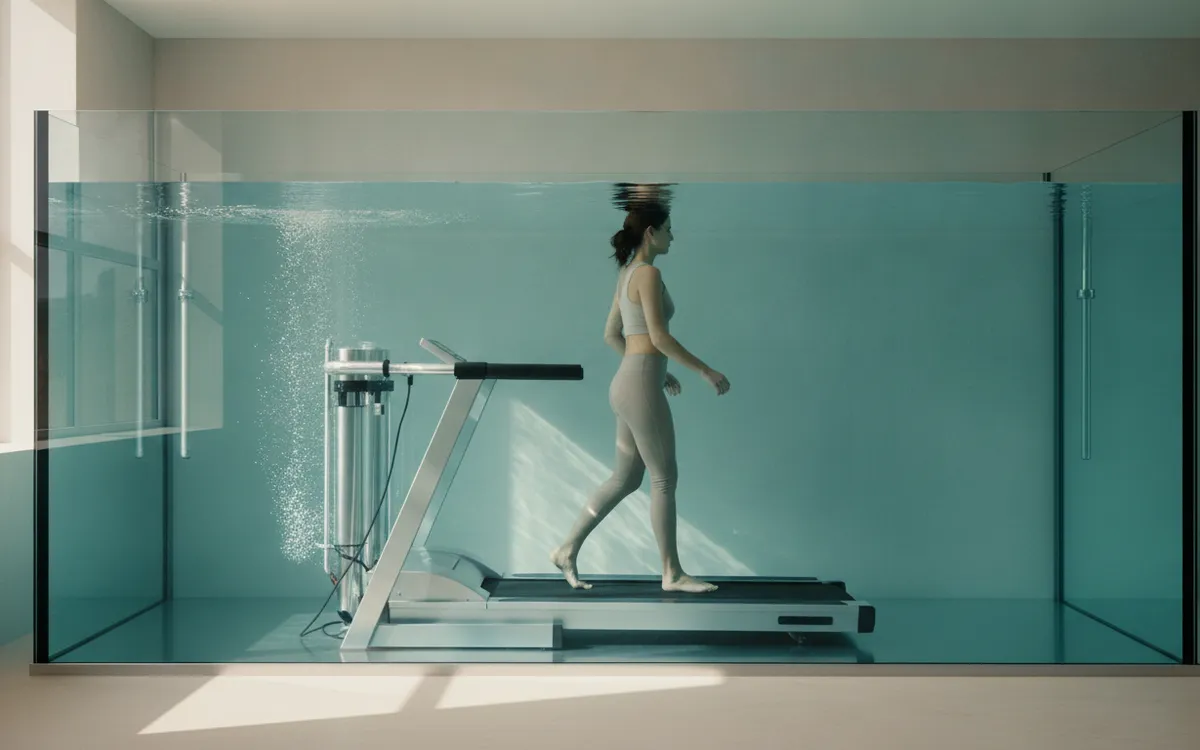
Underwater treadmills with viewing windows allow therapists to observe and correct gait abnormalities in real time. The water's resistance naturally slows movement, making it easier to retrain proper mechanics. This is especially valuable for conditions like stroke recovery, Parkinson's disease, and cerebral palsy.
Non-Swimmers and Water-Anxious Individuals
Walking is a universal movement. Underwater treadmills require no swimming ability and keep the head above water at all times, making them ideal for those who can't swim or have water anxiety. This accessibility makes them particularly valuable for seniors and children.
Precise Loading Control
For conditions requiring specific weight-bearing percentages, such as stress fractures, ankle sprains, or progressive joint conditions, underwater treadmills provide exact control over loading that swimming cannot match.
For a complete introduction to this modality, read our beginner's guide to underwater treadmills.
When to Choose Swimming
Swimming has its own distinct advantages:
Full-Body Cardiovascular Fitness
Swimming engages virtually every major muscle group simultaneously (chest, back, shoulders, core, glutes, and legs) while maintaining sustained heart rate elevation. For pure cardiovascular conditioning and calorie expenditure, swimming at moderate-to-vigorous intensity outperforms underwater treadmill walking.
Upper Body and Core Emphasis
If your primary goals involve upper body strength, shoulder rehabilitation, or core conditioning, swimming provides superior stimulus. Each stroke pattern targets different muscle groups: freestyle emphasises latissimus dorsi and shoulders; breaststroke targets chest and inner thighs; backstroke builds posterior chain strength. For shoulder-specific rehabilitation, see our shoulder hydrotherapy guide.
Weight Loss and Body Composition
For weight management, swimming generally burns more calories per hour than underwater treadmill walking due to greater total muscle mass engagement and typically higher exercise intensity. However, underwater treadmill walking with jet resistance can approach swimming-level calorie expenditure. For a detailed comparison, see our water therapy for weight loss guide.
Cost and Accessibility
Swimming is dramatically more accessible and affordable. Any pool, lake, or ocean provides the environment. Monthly pool memberships typically cost $40 to $120 vs. $200 to $600+ for regular underwater treadmill sessions. For home options, see our guide to home hydrotherapy pools.
Mental Health and Stress Relief
The rhythmic, meditative nature of swimming (combined with controlled breathing patterns and full-body water immersion) makes it particularly effective for stress reduction and mental health. See our article on mental health benefits of hydrotherapy.
Combining Both Modalities
For many people, the optimal approach combines both:
| Phase | Primary Modality | Secondary Modality | Example |
|---|---|---|---|
| Early rehabilitation | Underwater treadmill | Gentle pool exercises | Post-ACL: treadmill walking + pool ROM exercises |
| Mid-rehabilitation | Both equally | , | Treadmill for gait + swimming for cardiovascular fitness |
| Late rehabilitation / Return to fitness | Swimming | Occasional treadmill | Swimming 3x/week + treadmill 1x/week for gait monitoring |
| Ongoing fitness / Maintenance | Swimming | Pool exercises | Swimming + aquatic exercises for variety |
Specific Condition Recommendations
- Knee or hip arthritis: Underwater treadmill for controlled loading; swimming (backstroke/freestyle) for cardiovascular fitness. See knee pain and hip pain guides
- Back pain: Underwater treadmill for upright gait practice; swimming (backstroke to avoid extension) for decompression. See back pain guide
- Neurological conditions: Underwater treadmill for gait retraining; swimming for overall fitness and neuroplasticity stimulation
- Weight loss: Swimming for higher calorie burn; underwater treadmill for those who cannot swim or prefer walking. See weight loss guide
- Athletic recovery: Both valuable, treadmill for controlled active recovery; swimming for cross-training. See athletes' hydrotherapy guide
- Dog rehabilitation: Underwater treadmills are the gold standard for canine hydrotherapy. See our dog hydrotherapy guide
Temperature Considerations
| Activity | Ideal Temperature | Rationale |
|---|---|---|
| Underwater treadmill (rehab) | 32 to 34°C (90 to 93°F) | Warm enough for pain relief, cool enough for exercise |
| Underwater treadmill (fitness) | 28 to 31°C (82 to 88°F) | Cooler to prevent overheating during vigorous walking |
| Swimming (rehab / gentle) | 30 to 33°C (86 to 91°F) | Comfortable for low-intensity swimming |
| Swimming (fitness / laps) | 26 to 28°C (79 to 82°F) | Standard competitive pool temperature; prevents overheating |
For a complete temperature reference, see our pool temperature guide.
Frequently Asked Questions
Does an underwater treadmill burn more calories than swimming?
Generally no, swimming at moderate-to-vigorous intensity typically burns more calories per hour (400 to 900 kcal) than underwater treadmill walking (400 to 700 kcal) because swimming engages more total muscle mass. However, underwater treadmill walking with added jet resistance and incline can approach swimming-level calorie expenditure. The best choice depends on your ability, comfort, and specific goals rather than calorie burn alone.
Is an underwater treadmill better for rehabilitation than swimming?
For gait-specific rehabilitation (learning to walk again after surgery, stroke, or injury), underwater treadmills are superior because they train the actual walking pattern with controlled weight-bearing. For general conditioning and upper body rehabilitation, swimming may be better. Many rehabilitation programs use both modalities at different stages of recovery.
Can I get the same benefits from pool walking as an underwater treadmill?
Pool walking provides many similar benefits, reduced joint loading, water resistance, and hydrostatic pressure. However, underwater treadmills offer advantages: consistent walking surface, adjustable speed, jet resistance for progressive loading, and viewing windows for gait analysis. For cost-effective general fitness, pool walking is an excellent alternative. For precise rehabilitation, the underwater treadmill is preferable.
How deep should the water be for underwater treadmill walking?
Water depth determines weight-bearing load. Chest-deep water reduces body weight to approximately 25 to 35% of land weight. Waist-deep water reduces it to approximately 50%. Hip-deep water reduces it to approximately 60 to 70%. Your therapist will set the depth based on your specific condition, weight-bearing restrictions, and treatment goals, typically starting deeper and progressively reducing water depth as you heal.
Is swimming safe for people with joint problems?
Swimming is one of the safest exercises for people with joint problems because water buoyancy eliminates impact forces. However, certain strokes can stress specific joints, breaststroke can aggravate knee and hip problems, while butterfly strokes may stress the lower back. Freestyle and backstroke are generally the most joint-friendly options. For joint-specific guidance, see our condition guides for knee pain, hip pain, and shoulder pain.